Skip to content
Search Our Site:

    Project Feasibility Research Validates $3.4 Billion Riverfront Development


    Allegro_Whitepaper_Optimization

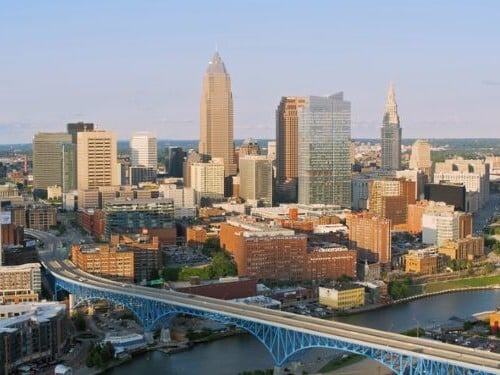
    A commercial real estate development company announced a $3.4 billion dollar riverfront development in Downtown Cleveland. The 35-acre project envisions 2,000 new residential units, 1.4 million square feet of non-residential development, 12 acres of parks, and additional parking to support the project. The ultimate goal is to seamlessly connect the riverfront to the city core.

    To strategically plan the project and secure necessary funding, the client required significant research and assumption validation. The team ultimately turned to Allegro for their unmatched consulting expertise and local real estate knowledge. 

    Allegro provided consulting and project feasibility support in three ways. 

    1. Pressure Testing Feasibility of Development

    The development proforma incorporated numerous assumptions related to costs and operational aspects of various asset classes, such as hotels, office spaces, and multi-family units.

    Allegro worked to validate these assumptions by utilizing market expertise, publicly available market data, and industry standards to pressure test rental rates, operating expenses, demand projections,  absorption rates, and stabilization periods for each asset class. Allegro also leveraged its strong industry relationships to help the client benchmark construction costs, taking into account the rapid changes the market is experiencing as a result of constraints related to the availability of materials and labor.

    Allegro then created a discounted cash flow model, incorporating the assumptions noted above, to evaluate potential levered and unlevered returns by development phase, asset class, and individual parcel development.

    2. Valuing Tax Increment Financing (TIF) Overlay Districts

    Tax increment financing (TIF) is a financing tool that cities and towns may use to help pay for property redevelopment and/or public infrastructure improvements. A TIF overlay district’s revenues, or Payments In Lieu of Taxes (PILOTs) are derived from the increased value of a property or group of properties in a district, which are then diverted toward funding of a specific project or geographic area.

    For the riverfront development initiative, Allegro created a sophisticated financial model to value PILOT payments that could be generated by a TIF overlay district. Allegro collected data for almost 3,000 parcels, including current and past market values, tax values, and values of existing abatements and TIFs. Allegro then created a dynamic model that allowed the client to simultaneously manipulate a variety of key assumptions. From there, the team developed a sensitivity analysis, showing how these assumptions would ultimately impact PILOT payments over decades.

    One assumption included in the analysis was the property appreciation rate. Allegro conducted a number of smaller studies on the impact of public infrastructure improvements on land values in Cleveland neighborhoods. These studies helped the client determine the appropriate ranges to include in the sensitivity analysis.

    3. Calculating the Economic Development Impact

    One of the most compelling ways to secure public funding for new development is by demonstrating the potential economic impact of the project. Using a tool called IMPLAN, Allegro determined the direct, indirect, and induced impacts of both the construction period and post-development period of the project.

    Direct impacts. The immediate effect new development has on the local economy because money is being spent directly in support of other businesses. This includes money spent to buy materials, hire construction workers, and rent equipment.

    Indirect impacts. The ripple effect of a development’s activities on other businesses in the area. For the riverfront development, this could mean restaurants around Cleveland buying more supplies due to increased demand or area hotels hiring more staff to accommodate increased visitors.

    Induced impacts. The result of the money flowing through the local economy due to the development and its employees. Induced impacts of the completed riverfront development could be the money spent at area bars, restaurants, and event venues from new residents or increased pedestrians using the space.

    The team conducted in-depth analysis of these impacts on city, regional, and state levels to supplement conversations with city planners and possible sources of funding.

    Adjusting Assumptions Over Time

    The riverfront development is a massive, multiphased project, expected to take anywhere from 15 to 20 years to fully implement. Given the magnitude of this development, all of Allegro’s analysis tools are dynamic, enabling frequent adjustments to all assumptions. This allows the client to update the model to account for changes in local market conditions as well as macro conditions that could impact project feasibility. This way, they are poised with the real-time information needed to execute this major transformation in Cleveland.